✦ In God We Trust · We build our future together ✦
Umbrella insurance · Wealth protection

Protect what you've built from one bad day

A lawsuit, a death or a disability can wipe out years of savings in a few months. Here is how families protect their income, their savings and their kids' future, in plain words.

English · Español · По-русски
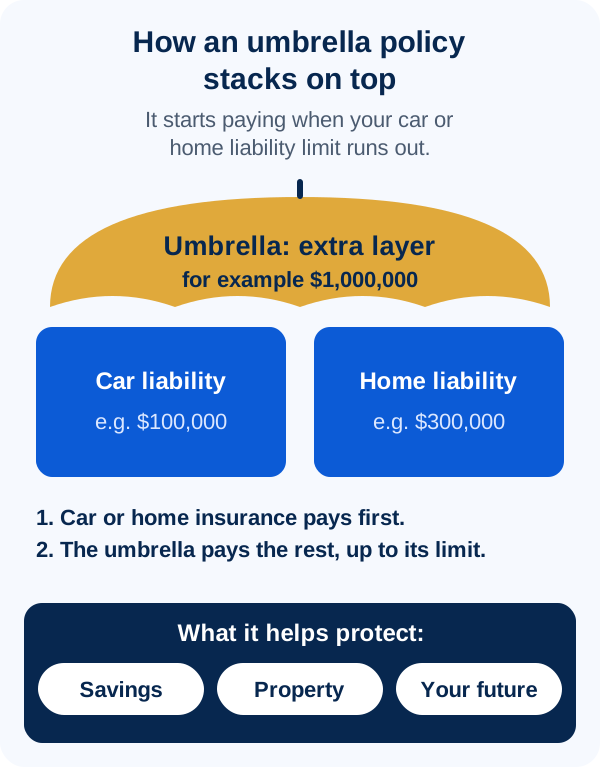
Diagram. An umbrella policy is an extra layer, for example $1,000,000, sitting on top of car liability (for example $100,000) and home liability (for example $300,000). Step 1: car or home insurance pays first. Step 2: the umbrella pays the rest, up to its limit. It helps protect savings, property and your future.

The short version

  • Your car and home policies pay only up to their liability limits. If a jury decides you owe more, the rest is on you.
  • In a real Florida case, a driver with a $100,000 policy faced an $8.47 million judgment.
  • An umbrella policy adds an extra layer, for example $1 million, on top of your car and home liability.
  • Wealth protection has three parts: lawsuits (umbrella), death (life insurance) and lost income (a plan for when you cannot work).

How an umbrella works

Think of your car and home liability as the first floor. The umbrella is a second floor built on top.

  1. Something serious happens: a crash you cause, a guest hurt at your home, a dog bite.
  2. Your car or home policy pays first, up to its limit.
  3. If the claim is bigger, the umbrella pays the rest, up to its own limit.

Most umbrella policies require you to carry certain liability limits on your car and home first. Many also help pay for your legal defense. The details depend on the policy, so we check yours with you.

A real Florida case: $100,000 of coverage, an $8.47 million judgment

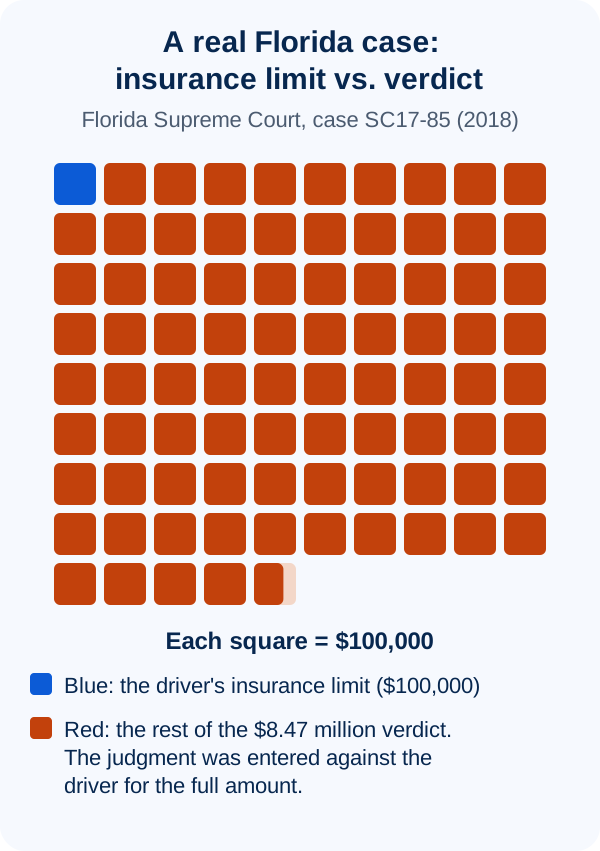
In August 2006, in Palm Beach County, a driver caused a crash that killed a 51-year-old husband and father of three. The driver had car insurance with a $100,000 liability limit.

A jury found the driver 100% at fault and awarded $8.47 million. The judgment was entered against the driver for the full amount. Years later the case reached the Florida Supreme Court over how the claim had been handled.

We do not share this to scare anyone. We share it because the gap between $100,000 and $8.47 million is real, and that is exactly the kind of gap an umbrella policy is built for.

Grid of 85 squares, each worth $100,000. One blue square is the at-fault driver's $100,000 insurance limit. The other squares, in red, are the rest of an $8.47 million jury verdict. The judgment was entered against the driver for the full amount. Source: Florida Supreme Court case SC17-85 (2018).
Real case, public court record. The case later went to the Florida Supreme Court over how the claim was handled.

Who should think about an umbrella?

  • You own a home, or you have savings or investments.
  • You have a teen driver in the house.
  • You have a pool, a trampoline or a dog.
  • You rent out a home or a room.
  • You own a boat.
  • You earn a good income, so your future paychecks are worth a lot.

Wealth protection: three things that can take a family's money

1. A lawsuit

Liability limits on your car and your home are the first line. An umbrella is the second. See how this works at home on our home insurance page.

2. A death

If the main earner dies, the paycheck stops. Life insurance can replace it, pay the mortgage and help pay for the kids' education.

3. A disability

If you cannot work for months, PIP and Social Security may pay little or nothing for a long time. Savings, uninsured motorist coverage for crashes and the right plan help keep the bills paid.

Real Florida cases: when the limit is far below the verdict

These come from public court records. We share them to show how large serious claims can be. Every case is different.

Real case

A $100,000 policy and an $8.47 million judgment

Palm Beach County · Florida Supreme Court, 2018 (crash in 2006)

What happened
A driver was found 100% at fault for a crash that killed a 51-year-old husband and father of three. The driver's car insurance had a $100,000 liability limit.
What was decided
A jury awarded $8.47 million, and the judgment was entered against the driver for the full amount. The case then went to the Florida Supreme Court over how the claim had been handled.
What it shows
A liability limit can be a tiny part of a serious verdict. The difference is a judgment against the person at fault.

Source: Florida Supreme Court, opinion in case SC17-85 (Sept. 20, 2018) (PDF)

Real case

$10,000 per person and about $1.4 million in verdicts

Hillsborough County · Florida Supreme Court, 2004 (crash in 1990)

What happened
A car insured for $10,000 per person and $20,000 per crash was driven by a driver who had been drinking. It crossed the center line and hit a car, killing a mother and badly hurting her young daughter.
What was decided
Juries set the damages at $911,400 for the mother's death and $500,000 for the daughter's injuries.
What it shows
Low limits can leave the people at fault facing amounts many times larger than their coverage.

Source: Florida Supreme Court, opinion in case SC01-2846 (2004), full text

The numbers behind it

$1.6 millionis the average lifetime economic cost of one crash death in the U.S. ($11.3 million when quality of life is counted).Source: NHTSA
$979,000is the average economic cost for each critically injured crash survivor.Source: NHTSA
$100,000 to $300,000is the typical liability limit on a home policy. Above the limit, the owner is responsible.Source: Insurance Information Institute
29%of U.S. adults say they would stay financially secure for more than 2 years if a main earner died.Source: LIMRA and Life Happens

Check your own protection in 5 minutes

  • Write down the liability limits on your car policy (for example 100/300).
  • Write down the personal liability limit on your home, condo or renters policy.
  • Add up what you would want to protect: savings, investments, other property and years of future income.
  • Do you have a teen driver, a pool, a dog, a boat or a rental? Those raise the stakes.
  • Check that every car, home and driver in your household is listed under your umbrella.
  • Send us your policies and we'll check your coverage.

Keep reading

Frequently asked questions

What is an umbrella policy, in plain words?

It is extra liability insurance. It sits on top of your car and home policies and pays after their limits run out, up to its own limit.

Does an umbrella cover me when I drive?

Usually yes. A personal umbrella sits above the liability on your car policy. In most policies it also covers family members who live with you. Check your policy for the details.

Does an umbrella pay for my own injuries?

No. An umbrella is for harm you cause to other people. For your own injuries in a crash, look at PIP and uninsured motorist coverage.

How much umbrella coverage do I need?

Start by adding up what a serious lawsuit could put at risk: savings, investments, other property and years of future income. We will help you compare that with the limits available.

Do I need to be rich to need an umbrella?

No. Families with a good income, a teen driver, a pool or a dog can have a lot at stake too. A large judgment can affect your finances for years, not only what you own today.

What does an umbrella not cover?

It depends on the policy. Umbrellas usually do not cover business activities, harm you cause on purpose or damage to your own property. We will go over the exclusions with you.

How big is your gap? Let's look together.

Send us your car and home policies and we'll check your coverage. We'll show you your limits, what they protect, and what an umbrella would add. We call back within 1 hour during business hours.

Send us your policy and we'll check your coverage →

📄 Send us your policy – we'll check your coverage

A photo of the first page (declarations page) is enough.

M&K Agency · 33550 S Dixie Hwy, Suite 102, Florida City, FL 33034 · Mon–Fri 9–6, Saturday by appointment · Florida license #L109526

Talk to a licensed agent

Takes 30 seconds. A real agent calls you back fast.

🔒 Your info stays private. No spam, ever.

This page is general information, not legal or financial advice and not policy language. What is covered depends on your policy, its limits and its exclusions. Stories marked "Example" are made up to explain the idea. "Real case" items come from public court records linked below, and every case is different. No one can promise how a claim will turn out.

Sources

Facts on this page were checked against these sources on October 3, 2026.