
ATV, UTV and dirt bike insurance in Florida: for the trail, the ranch and the kids who ride.
Quick answer: Off-road vehicles flip, collide and throw riders, and the injured person can be a family member or a friend. In Florida these machines need a title, follow special road rules, and are often left out of home policies. We check your coverage and explain it in your language.
Talk to a licensed agent
Takes 30 seconds. A real agent calls you back fast.
In South Florida, ATVs and side-by-sides do real work on groves, nurseries and large lots, and they are a weekend ride for families from Homestead to the Panhandle. They are also involved in serious injuries: the most common are fractures and head and neck injuries.
Below are the Florida rules every owner should know, the gaps that catch families off guard and the coverage questions to ask, in plain words with links to the law.
Off-road vehicles: what the numbers say
- ~102,000emergency-room injuries a year in the U.S. involved off-highway vehicles (estimated yearly average, 2019 to 2023).Source
- 107reported off-highway vehicle deaths in Florida from 2019 to 2021, the sixth-highest total of any state.Source
- 34%of off-highway vehicle injuries treated in emergency rooms in 2023 were to the head and neck; 29% were fractures.Source
- 16Under this age, every ATV rider in Florida must wear a DOT helmet and eye protection.Source
Where off-road owners get caught short
A friend or relative gets hurt
The injured person may be someone the owner knows: a passenger, a neighbor’s kid, a cousin on a borrowed machine. Liability and medical payments are what usually respond.
The home policy stops at the property line
Many homeowners policies limit or exclude motorized vehicles, especially off your land. Read the section on motor vehicles before you count on it.
Theft and storm damage
ATVs and UTVs are easy to load and steal, and a shed is not a garage in a hurricane. Physical damage coverage is a separate decision.
Coverage to ask about for an ATV, UTV or dirt bike
Liability
Injuries and damage you or a permitted rider cause to others, up to your limits, plus legal defense.
Medical payments
Helps with medical bills for you and your passengers, regardless of fault.
Collision and comprehensive
Damage to the machine from a rollover or crash, theft, fire, flood or a falling tree.
Accessories and added equipment
Winches, plows, lights, racks and custom parts, if listed or included.
Uninsured motorist
Helps if a driver with no insurance injures you, where the policy offers it.
Trailer
The trailer you haul it on, if included.
These are general descriptions. Availability, limits and exclusions depend on the policy.
What counts as an off-highway vehicle in Florida
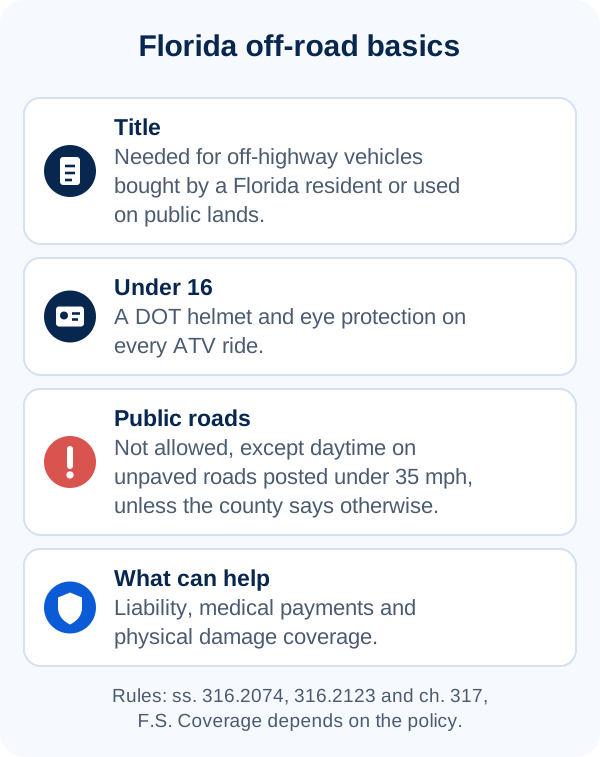
Florida groups ATVs, two-rider ATVs, ROVs (side-by-sides) and off-highway motorcycles (dirt bikes) as off-highway vehicles when they are used off the roads and are not registered for highway use (s. 317.0003). For the safety law, an ATV is an off-highway vehicle 55 inches wide or less, weighing 1,500 pounds or less dry, built for recreation on three or more off-road tires (s. 316.2074).
Titles: yes, your ATV needs one
An off-highway vehicle bought by a Florida resident, or owned by a resident and used on Florida’s public lands, must be titled under chapter 317. When you sell one, you must hand over the title with the transfer filled in (s. 317.0006). A title also makes a theft claim much easier to prove.
Kids, helmets and public roads
- Anyone under 16 riding or driving an ATV must wear a helmet that meets DOT standards and eye protection (s. 316.2074).
- If a crash kills someone or injures someone who is then treated by a doctor, each ATV operator must give notice of the crash.
- ATVs are not allowed on public roads, except in the daytime on an unpaved road with a posted limit under 35 mph (s. 316.2123).
- A county can vote to opt out of that exception, or to designate specific unpaved roads for daytime ATV use.
- Where road use is allowed, the operator must be a licensed driver, or a minor under the direct supervision of one, and must show proof of ownership if an officer asks.
Before you lend it
A borrowed ATV with a passenger is a common setup for a serious injury. Before you hand over the key, check whether your policy covers other riders and passengers.
A quick check for every off-road vehicle you own
- Is each machine titled and listed on a policy, not just on your homeowners?
- Does the policy cover other riders you allow and passengers?
- Do you have medical payments coverage, and how much?
- Are your liability limits high enough for an injury claim?
- Are winches, plows, lights and other add-ons listed?
- Is the machine used for work on a farm or business? Tell your agent; it can change the coverage you need.
A personal agent when it counts: at claim time
M&K Agency is a family-owned agency in Florida City, in the middle of South Dade’s farm country, with more than 5,000 clients across Florida and a team of 12 who speak English, Spanish and Russian.
After a rollover, a theft or a storm, call or message us. We help you report the claim, explain what the policy pays and stay with you until it is settled. Send us your policy and we’ll check your coverage.
33550 S Dixie Hwy, Suite 102
Florida City, FL 33034
English · Español · По-русски
ATV, UTV and dirt bike insurance in Florida: common questions
Does my ATV need a title in Florida?
Yes, in most cases. An off-highway vehicle bought by a Florida resident, or owned by a resident and used on public lands, must be titled under chapter 317, Florida Statutes.
Can I ride my ATV on the road in Florida?
Generally no. The exception is daytime riding on an unpaved road with a posted speed limit under 35 mph, and a county can opt out of it or designate specific unpaved roads. The rider must be a licensed driver or a supervised minor and carry proof of ownership.
Does my homeowners policy cover my ATV or UTV?
Often only in a limited way, and many home policies exclude motorized vehicles away from the residence. Send us your home policy and we will tell you what it says.
Do kids need helmets on an ATV in Florida?
Yes. Anyone under 16 who operates or rides an ATV must wear a helmet that meets DOT standards and eye protection.
Is a side-by-side (UTV/ROV) covered the same as an ATV?
Florida law treats ROVs as off-highway vehicles too, but policies can treat them differently because of size, seating and use. Tell us exactly what you ride and how you use it.
Do you help with off-road claims?
Yes. Call us or message us on WhatsApp. A licensed agent helps you report the claim and explains each step in English, Spanish or Russian.
Keep reading
Send us your policy and we’ll check your coverage
A licensed agent reads your current policy, shows you the gaps in plain words and helps you fix them. Call us, or leave your number and we’ll contact you within an hour during business hours.
Have an agent call meCall (305) 859-3953
📄 Send us your policy – we'll check your coverage
A photo of the first page (declarations page) is enough.
This article is general information, not legal advice or policy language. Coverage depends on the terms, limits and exclusions of your policy, and eligibility rules can change. Talk with a licensed agent about your situation.
Sources
Facts on this page were checked against these sources on October 3, 2026.
- U.S. Consumer Product Safety Commission: 2024 Report of Deaths and Injuries Involving Off-Highway Vehicles (PDF)
- Florida Statutes s. 316.2074 (2026): all-terrain vehicles
- Florida Statutes s. 316.2123 (2026): operation of an ATV on certain roadways
- Florida Statutes s. 317.0003 (2026): off-highway vehicle definitions (ATV, ROV, OHM)
- Florida Statutes s. 317.0006 (2026): certificate of title required for off-highway vehicles
Areas we serve
We serve South Florida from our Florida City office, in person and by phone, WhatsApp, text and email.