
Boat insurance in Florida: liability on the water, a plan for hurricane season.
Quick answer: In Florida, the two biggest money risks for a boat owner are hurting someone on the water and a named storm. A good policy is built around both, plus towing and the people who ride with you. We check yours and explain it in your language.
Talk to a licensed agent
Takes 30 seconds. A real agent calls you back fast.
Florida has more registered boats than any other state, and South Florida waters are some of the busiest in the country. That means more chances of a collision, a guest hurt on board or damage to someone else’s boat or dock. Then, from June through November, every owner needs a storm plan: haul out, move or tie down.
This page explains the Florida rules that matter for boat owners, the coverage gaps we see most often and the questions to ask your agent, in plain words and with links to the law.
Boating in Florida: what the numbers say
- 1,027,742registered vessels in Florida in 2025, the most in the nation.Source
- 694reportable boating accidents in Florida in 2025. Collision with a fixed object was the leading type (35%).Source
- 72accidents in Monroe County (the Keys) in 2025, more than any other county.Source
- 67%of operators in Florida’s fatal boating accidents in 2025 had no formal boater education.Source
Where Florida boat owners get caught short
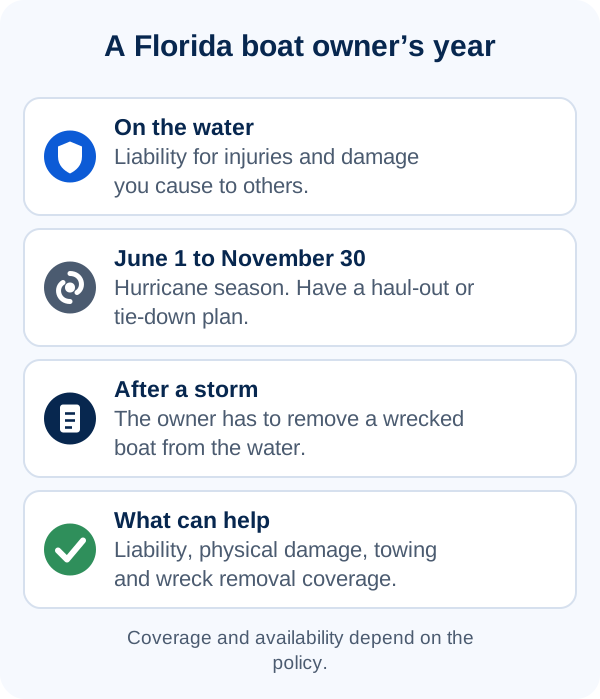
Someone gets hurt
A guest falls on deck, a swimmer is struck, another boat is hit. Liability and medical payments are what usually respond, and the limits matter.
The storm and the days after
Hauling out, moving the boat, wreck removal and cleanup can add up even before repairs. Some policies help with part of these costs; many have special storm deductibles.
Far from the dock
An engine that won’t start offshore or a soft grounding on a flat means a tow. Check what your policy says about towing and assistance.
Coverage to ask about on a Florida boat policy
Liability
Injuries and damage you cause to others, including other boats, docks and swimmers, up to your limits, plus legal defense.
Physical damage
Hull, engine and equipment after a collision, sinking, fire, theft or storm, based on how the policy values the boat.
Medical payments and uninsured boater
Medical bills for you and your guests, and help when another boater who injures you has no insurance.
Towing and on-water assistance
A tow back to the ramp or marina, fuel delivery or a jump start, if included.
Wreck removal and hurricane haul-out
Some policies help pay to remove a sunken boat or to haul it out before a named storm.
Trailer, gear and personal items
Your trailer, electronics, fishing gear and other equipment, if listed or included.
These are general descriptions. Availability, limits, deductibles and exclusions depend on the policy.
Hurricane season: what Florida law says about marinas
The Atlantic hurricane season runs from June 1 to November 30 (National Hurricane Center). Florida law does not let marinas require owners to take their boats out when a hurricane watch or warning is issued, so that people’s safety comes first. But after a tropical storm or hurricane watch, the marina may take reasonable steps to secure your boat and charge a reasonable fee. If your contract includes the notice the law describes, the marina may even move your boat if you don’t remove it promptly, and it is generally not liable for storm damage to your vessel (s. 327.59).
FWC’s advice is to trailer the boat and move it as far from tidal waters as you can. If it must stay in the water, double the lines, add spring lines, attach them high on the pilings for surge, protect against chafe and keep the batteries charged for the bilge pumps. Never stay aboard during the storm (FWC).
After the storm: a wrecked boat is still your responsibility
In Florida, an owner may not leave a derelict vessel on state waters for more than 24 hours. If the boat became derelict because of a hurricane, the owner is not charged if he or she documents what happened and removes or repairs it within 45 days after the hurricane has passed (s. 823.11). Raising and removing a sunken boat can be expensive, which is why wreck removal coverage is worth asking about.
Accidents, reports and life jackets
If an accident causes an injury needing more than first aid, a death or disappearance, or at least $2,000 in damage, the operator must send a written report to FWC (s. 327.301). Nationally, where life jacket use was known, 87% of people who drowned in boating incidents in 2024 were not wearing one (USCG).
Boater ID
Anyone born on or after January 1, 1988, needs a Boating Safety Education ID card or another accepted document to operate a boat with a motor of 10 horsepower or more (s. 327.395). Tell your agent who drives your boat.
A quick check of your boat policy before the next storm
- Read the named storm or hurricane deductible on your declarations page.
- Ask whether your policy helps with hurricane haul-out or moving the boat.
- Check for wreck removal and how much it pays.
- Read your marina or storage contract for the hurricane clause and fees.
- Check your liability limits and whether guests and other operators are covered.
- Make sure your cruising area in the policy matches where you really go, including the Keys and the Bahamas.
A personal agent when it counts: at claim time
M&K Agency is a family-owned agency in Florida City, the gateway to the Keys, with more than 5,000 clients across Florida and a team of 12 who speak English, Spanish and Russian.
After an accident or a storm, call or message us. We help you report the claim, explain what the policy pays and stay with you until it is settled. Send us your policy and we’ll check your coverage.
33550 S Dixie Hwy, Suite 102
Florida City, FL 33034
English · Español · По-русски
Boat insurance in Florida: common questions
Is boat insurance required in Florida?
Florida’s boating laws set insurance rules for rental businesses, not a general insurance requirement for private boat owners. A marina, storage or HOA contract may require proof of liability coverage, so read yours. Either way, an owner can be sued for injuries or damage the boat causes.
Can my marina make me take my boat out before a hurricane?
Florida law doesn’t let a marina require you to remove your boat when a hurricane watch or warning is issued. After a watch, the marina may take reasonable steps to secure your boat and charge a reasonable fee, and with the right notice in your contract it may move the boat if you don’t remove it promptly.
Does boat insurance pay to haul out my boat before a storm?
Some policies help pay part of the cost of hauling out or moving a boat ahead of a named storm. It depends on the policy, so ask before the season starts.
What if my boat sinks in a hurricane?
You are responsible for getting it out of the water. Florida gives owners 45 days after a hurricane to remove or repair a boat that became derelict because of the storm, if they document what happened. Wreck removal coverage, if your policy has it, can help with the cost.
Does my homeowners policy cover my boat?
Often only in a limited way for small boats, and many home policies exclude larger or faster boats and liability on the water. Send us your home policy and we will tell you what it says.
Do you help with boat claims?
Yes. Call us or message us on WhatsApp after an accident or storm. A licensed agent helps you report the claim and explains each step in English, Spanish or Russian.
Keep reading
Send us your policy and we’ll check your coverage
A licensed agent reads your current policy, shows you the gaps in plain words and helps you fix them. Call us, or leave your number and we’ll contact you within an hour during business hours.
Have an agent call meCall (305) 859-3953
📄 Send us your policy – we'll check your coverage
A photo of the first page (declarations page) is enough.
This article is general information, not legal advice or policy language. Coverage depends on the terms, limits and exclusions of your policy, and eligibility rules can change. Talk with a licensed agent about your situation.
Sources
Facts on this page were checked against these sources on October 3, 2026.
- FWC: 2025 Florida Boating Accident Statistical Report, introduction and summary (PDF)
- U.S. Coast Guard: 2024 Recreational Boating Statistics (PDF)
- NOAA National Hurricane Center: Tropical cyclone climatology (season dates)
- Florida Statutes s. 327.59 (2026): marina evacuations (hurricanes)
- Florida Statutes s. 823.11 (2026): derelict vessels; removal
- FWC: Storm prep resources for boaters
- Florida Statutes s. 327.301 (2026): written reports of boating accidents
- Florida Statutes s. 327.395 (2026): boating safety education
- Florida Statutes s. 327.35 (2026): boating under the influence
Areas we serve
We serve South Florida from our Florida City office, in person and by phone, WhatsApp, text and email.