
Golf cart insurance in Florida: for the neighborhood, the community and the grandkids in the back seat.
Quick answer: In Florida a golf cart can only use roads a city or county has designated, and drivers under 18 need a learner’s or driver license. A street-legal low-speed vehicle (LSV) follows different rules. Either way, an injured passenger or pedestrian can mean a serious claim. We check your coverage and explain it in your language.
Talk to a licensed agent
Takes 30 seconds. A real agent calls you back fast.
Golf carts are everywhere in Florida: retirement communities, beach towns, gated neighborhoods, RV parks and farms in South Dade. Many families treat them like toys. Florida law and an injury claim treat them more seriously.
This page explains, in plain words and with links to the law, where you may drive a golf cart, who may drive it, how an LSV is different, and which coverage gaps to close.
Golf carts and LSVs: the numbers in Florida law
- 20 mphA golf cart, under Florida law, is a vehicle built for golf courses that cannot go faster than 20 mph.Source
- 18Under 18, a golf cart driver on public roads must have a learner’s or driver license; 18 and over, a government photo ID.Source
- 25 mphA low-speed vehicle has a top speed over 20 mph and up to 25 mph, and it must be registered and insured.Source
- 35 mphLSVs may only be driven on streets with a posted speed limit of 35 mph or less (they may cross faster roads at intersections).Source
Where golf cart owners get caught short
A passenger falls out
Many golf carts have no doors or seat belts. A sharp turn with a child or grandparent on the back bench can mean a hospital visit. Medical payments and liability are what usually respond.
Home policy limits
Some homeowners policies give limited golf cart coverage, often only in certain places, such as on a golf course or inside your community. Check before you drive to the store.
The cart was converted into an LSV
An LSV is a registered motor vehicle with its own insurance requirements. A converted cart that is still insured like a golf cart can leave a gap.
Coverage to ask about for a golf cart or LSV
Liability
Injuries and damage you or a permitted driver cause to others, up to your limits, plus legal defense.
Medical payments
Helps with medical bills for you and your passengers, regardless of fault.
Collision and comprehensive
Damage to the cart from a crash, theft, fire, flood or a falling tree.
Uninsured motorist
Helps if a driver with no insurance injures you or your passengers, where the policy offers it.
Accessories and custom parts
Lift kits, custom seats, enclosures, lights and sound systems, if listed or included.
PIP and property damage for LSVs
A registered LSV needs the Florida motor vehicle minimums, PIP and property damage liability.
These are general descriptions. Availability, limits and exclusions depend on the policy.
Where you may drive a golf cart in Florida
Driving a golf cart on public roads is prohibited except as the law allows (s. 316.212). Mainly, that means a county road or city street that the county or city has designated for golf carts and posted with signs. Golf carts may cross a state highway only at crossings the state has approved.
- Only from sunrise to sunset, unless the local government allows night driving and the cart has headlights, brake lights, turn signals and a windshield.
- Every golf cart needs efficient brakes, reliable steering, safe tires, a rearview mirror and red reflectors front and rear.
- A driver under 18 must have a learner’s or driver license; a driver 18 or older must carry a government photo ID.
- Cities and counties can pass stricter rules and can allow carts on certain sidewalks.
- Retirement communities have their own section of the law (s. 316.2125).
Golf cart or low-speed vehicle?
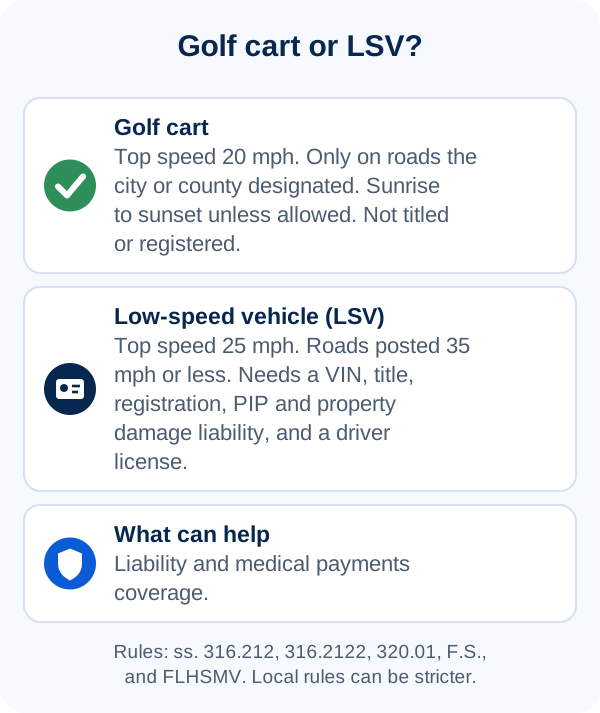
A golf cart cannot go faster than 20 mph; a low-speed vehicle goes over 20 and up to 25 mph (s. 320.01). An LSV may use streets posted at 35 mph or less, must have headlamps, stop lamps, turn signals, tail lamps, reflectors, a parking brake, mirrors, a windshield, seat belts and a VIN, must be registered and insured, and the driver needs a valid driver license (s. 316.2122).
Golf carts are not titled or registered in Florida (FLHSMV TL-63). To turn one into an LSV, the owner needs an inspection, a Florida-assigned VIN, a title and registration, and proof of PIP and property damage liability (FLHSMV).
Kids and golf carts
A young teen without a learner’s license may not drive a golf cart on public roads in Florida. If teens drive yours inside the community, ask your agent how the policy treats them.
A quick check for your golf cart or LSV
- Is your cart a golf cart or a registered LSV? The coverage you need is different.
- Does your policy cover the cart on public roads, not only on your property or the golf course?
- Are family members and guests who drive it covered?
- Do you have medical payments for passengers?
- Are lift kits, enclosures and other upgrades listed?
- Where is it parked during a hurricane?
A personal agent when it counts: at claim time
M&K Agency is a family-owned agency in Florida City with more than 5,000 clients across Florida and a team of 12 who speak English, Spanish and Russian.
If someone is hurt or the cart is stolen or damaged, call or message us. We help you report the claim, explain what the policy pays and stay with you until it is settled. Send us your policy and we’ll check your coverage.
33550 S Dixie Hwy, Suite 102
Florida City, FL 33034
English · Español · По-русски
Golf cart insurance in Florida: common questions
Can I drive a golf cart on the street in Florida?
Only where the law allows: mainly county roads and city streets that the local government has designated for golf carts and posted with signs, from sunrise to sunset unless night driving is authorized. Check your city and county rules too.
How old do you have to be to drive a golf cart in Florida?
On public roads, a driver under 18 must have a valid learner’s or driver license, and a driver 18 or older must have a valid government-issued photo ID (s. 316.212, Florida Statutes).
Does a golf cart need insurance in Florida?
Golf carts are not titled or registered in Florida, so there is no registration insurance requirement. But an injury claim does not care: liability and medical payments coverage protect you and your passengers. An LSV is different and must be insured.
What is the difference between a golf cart and an LSV?
A golf cart cannot exceed 20 mph. A low-speed vehicle goes over 20 and up to 25 mph, has safety equipment like seat belts and a VIN, is titled and registered, needs PIP and property damage liability, and can use streets posted at 35 mph or less.
Does my homeowners policy cover my golf cart?
Sometimes, but often only in a limited way or in certain places. Send us your home policy and we will tell you what it says about golf carts.
Do you help with golf cart claims?
Yes. Call us or message us on WhatsApp. A licensed agent helps you report the claim and explains each step in English, Spanish or Russian.
Keep reading
Send us your policy and we’ll check your coverage
A licensed agent reads your current policy, shows you the gaps in plain words and helps you fix them. Call us, or leave your number and we’ll contact you within an hour during business hours.
Have an agent call meCall (305) 859-3953
📄 Send us your policy – we'll check your coverage
A photo of the first page (declarations page) is enough.
This article is general information, not legal advice or policy language. Coverage depends on the terms, limits and exclusions of your policy, and eligibility rules can change. Talk with a licensed agent about your situation.
Sources
Facts on this page were checked against these sources on October 3, 2026.
- Florida Statutes s. 316.212 (2026): operation of golf carts on certain roadways
- Florida Statutes s. 320.01 (2026): definitions (golf cart, low-speed vehicle)
- Florida Statutes s. 316.2122 (2026): low-speed vehicles on certain roadways
- Florida Statutes s. 316.2125 (2026): golf carts within a retirement community
- FLHSMV: Low-speed vehicles and golf cart conversions
- FLHSMV procedure TL-63: Low-speed vehicles (PDF)
Areas we serve
We serve South Florida from our Florida City office, in person and by phone, WhatsApp, text and email.